Key facts
- Tendonitis, tendinosis, tendinopathy are not interchangeable: tendonitis is acute inflammation, tendinosis is chronic degeneration with little inflammation, and tendinopathy is the umbrella clinical term covering both.
- What TAME is: transcatheter arterial microembolization — a day-procedure, image-guided technique that reduces the abnormal blood vessel growth (neovascularity) driving chronic tendon pain.
- Conditions treated: Achilles tendinosis, tennis elbow (lateral epicondylitis), golfer's elbow (medial epicondylitis), plantar fasciitis, and other refractory tendinopathies, for patients who haven't responded to conservative treatment.
- Evidence status: the strongest data is for Achilles tendinopathy and lateral epicondylitis (multiple published cohorts); evidence for some other tendons, including de Quervain's, is much more limited and largely anecdotal at this stage.
Anyone who has been told they have "tendonitis" that won't settle after months of physiotherapy, injections and rest has likely run into a terminology problem as much as a treatment one. The tendon condition causing persistent pain in conditions like Achilles tendinopathy, tennis elbow, or plantar fasciitis is very often not actually inflammatory by the time it's chronic — and that distinction matters, because it's central to why an emerging image-guided technique, transcatheter arterial microembolization (TAME), has become a genuine option for patients who've exhausted conventional treatment.
Tendonitis, tendinosis, tendinopathy: sorting out the terms
These three words get used interchangeably in casual conversation, but they describe different things, and the distinction has real treatment implications.
| Term | What it actually means |
|---|---|
| Tendonitis (tendinitis) | True inflammation of the tendon — the "-itis" suffix means inflammation. Involves inflammatory cells (macrophages, lymphocytes, neutrophils), typically from an acute or early overuse injury. Usually self-limiting. |
| Tendinosis | Chronic, non-inflammatory degeneration of the tendon — the "-osis" suffix means a diseased or degenerative state. Characterised by collagen disorganisation, an inadequate reparative response, and — critically — abnormal new blood vessel growth (neovascularisation) rather than classic inflammatory cells. |
| Tendinopathy | The umbrella clinical term for tendon pain and dysfunction, used regardless of whether the underlying pathology is inflammatory, degenerative, or a mix of both. Most clinicians now use this term by default, since the exact histology usually isn't known without a biopsy. |
The reason this matters clinically: most chronic tendon pain that's persisted for months is tendinosis, not tendonitis, despite still commonly being called "tendonitis" in everyday language. That has direct treatment consequences — anti-inflammatory measures (rest, NSAIDs, corticosteroid injection) target an inflammatory process that, by the chronic stage, is often no longer the main driver of pain.
What's actually happening in chronic tendinopathy
As a tendon moves from acute injury to chronic tendinosis, several changes occur at the tissue level:
- Collagen disorganisation — the normally parallel, organised collagen fibres become disordered and structurally weaker
- Neovascularisation — new, abnormal blood vessels grow into the tendon, particularly at the site of pain, visible on Doppler ultrasound as increased blood flow
- Accompanying nerve ingrowth — these new vessels bring small sensory nerve fibres with them, and elevated levels of glutamate (a pain-signalling neurotransmitter) have been found in the painful tendon tissue alongside this neovascularity
- Matrix dysregulation — increased matrix metalloproteinase (MMP) activity and reduced levels of their natural inhibitors (TIMPs) drive ongoing collagen breakdown
- Elevated VEGF — vascular endothelial growth factor is upregulated, promoting the very neovascularisation that appears to sensitise the tendon to pain
This neovascularity-pain relationship is the whole rationale behind TAME. It's the same underlying concept behind genicular artery embolisation for knee osteoarthritis — abnormal blood flow to a chronically painful, degenerating tissue is targeted directly, on the basis that reducing it reduces both the neovascularity and the pain signalling that travels alongside it.
How TAME works
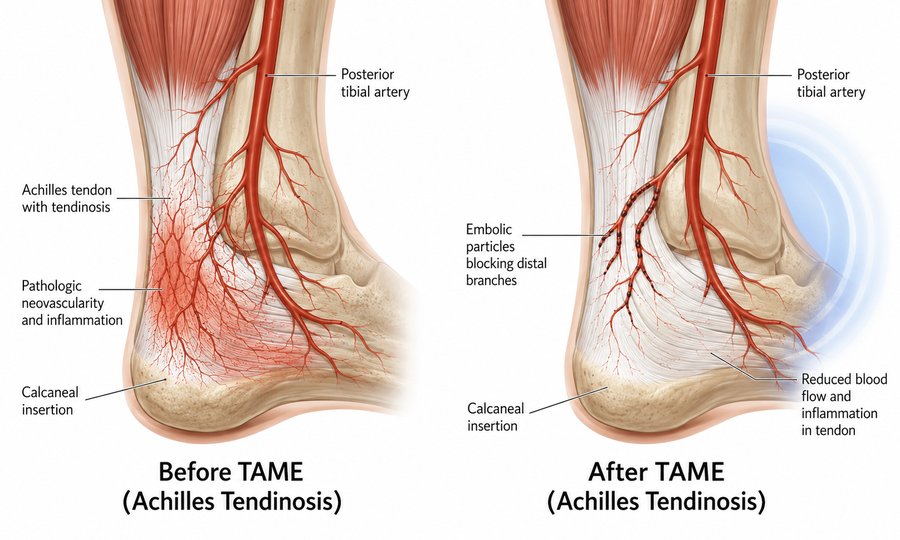
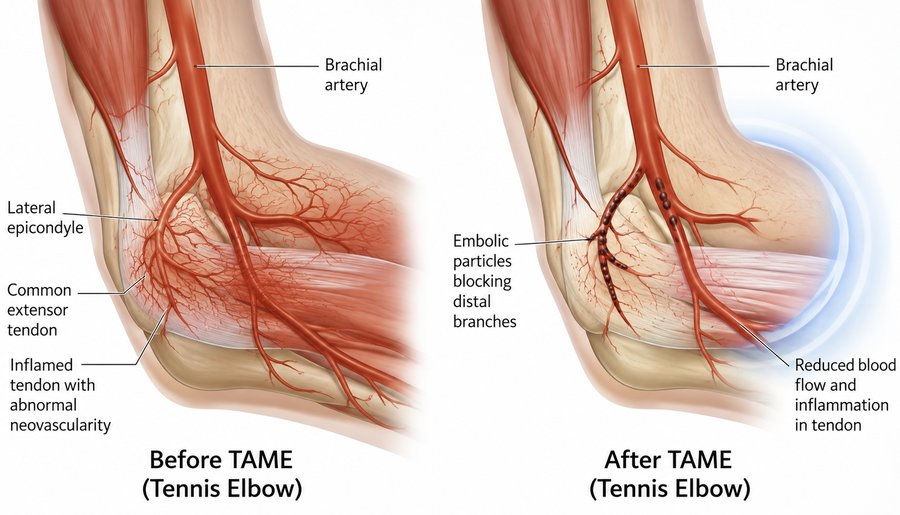
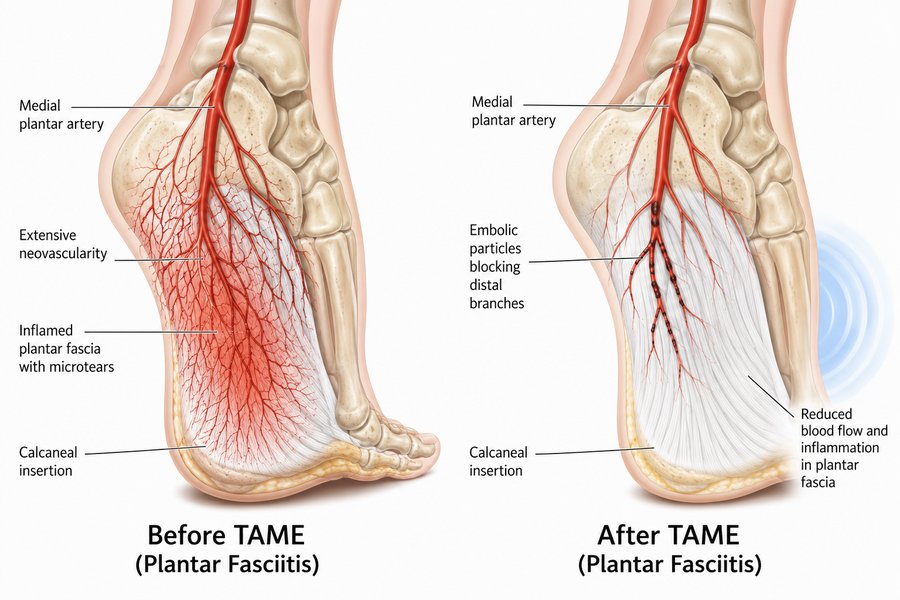
Transcatheter arterial microembolization is a minimally invasive, image-guided procedure that reduces blood flow to the abnormal, hypervascular tissue within a chronically painful tendon. A thin catheter is guided — typically from a small access point at the wrist or groin — to the small arteries supplying the affected tendon. Using X-ray angiography, the abnormal "blush" of hypervascularity is identified and graded, and a temporary embolic agent is injected to reduce blood flow specifically to that abnormal tissue.
It's performed under local anaesthetic, typically takes under an hour, and is done as a day case. Like GAE for the knee, it doesn't repair or remove the degenerated tendon tissue itself — it targets the abnormal vascular and nerve supply that appears to be driving the pain.
A note on the embolic agent: imipenem/cilastatin
One detail worth explaining, since it looks unusual at first glance: much of the published TAME literature uses imipenem/cilastatin sodium — ordinarily an antibiotic — as the embolic agent, not for any antimicrobial purpose. When injected into the target artery, the powder precipitates and forms a temporary embolic material that reduces blood flow for a period before being resorbed, making it a controllable, transient embolic agent rather than a permanent one. This off-label use was pioneered in Japan alongside the development of TAME itself, and has since been used safely across large published cohorts; more recently, alternative temporary embolic agents (such as gelatin sponge particles) have also been reported, partly to sidestep any theoretical concern around using an antibiotic-based agent outside its intended indication.
Which tendon conditions TAME has been used for
Achilles tendinosis
This is where the strongest evidence currently sits. A 2025 multicentre retrospective study of 82 patients with chronic Achilles tendinopathy refractory to conservative treatment, treated with TAME using imipenem/cilastatin, reported pain scores (NRS) improving from 6.7 to 1.5 over 24 months, with function scores (VISA-A) improving from 48.4 to 82.2, and clinical success — a 50% or greater reduction in pain — achieved in 81.7% of patients at 12 months.
Tennis elbow (lateral epicondylitis)
Lateral epicondylitis was one of the earliest applications of this technique, pioneered by Dr Yuji Okuno and colleagues in Tokyo, whose prospective study of 52 patients with tennis elbow refractory to conservative treatment showed durable improvement in pain and function at midterm follow-up, first presented at the Society of Interventional Radiology's 2019 annual meeting. Subsequent case series have reported clinical success in the majority of patients treated.
Golfer's elbow (medial epicondylitis)
Medial epicondylitis affects the common flexor tendon origin, the anatomical mirror of lateral epicondylitis's common extensor origin, and is approached with the same embolization principle — targeting the abnormal vessels supplying the affected tendon origin. Published data specifically for medial epicondylitis is more limited than for its lateral counterpart, but the technique and rationale are the same.
Plantar fasciitis
Plantar fasciopathy — degeneration of the plantar fascia rather than a true tendon, but sharing the same neovascularity-driven pain mechanism — has been treated with TAME in case reports and small case series, including as part of a mixed cohort of refractory tendinopathies where pain scores improved substantially at short-term follow-up. A recent narrative review identified Achilles tendinopathy and plantar fasciopathy as the two clearest indications for TAME in the foot and ankle.
De Quervain's tenosynovitis and other conditions
De Quervain's affects the tendon sheath (tenosynovium) at the base of the thumb rather than the tendon body itself, and while the same hypervascularity-driven pain mechanism plausibly applies, we haven't found a published TAME series specific to this condition — it's worth naming honestly as an area where the evidence isn't there yet, rather than implying otherwise. Rotator cuff tendinopathy, patellar tendinopathy, and iliotibial band syndrome have each appeared in small case series alongside the more established indications.
What's established: a 2024 systematic review and meta-analysis (5 studies, 97 procedures in 74 patients) found consistent, statistically significant pain reduction across tendinopathy embolization procedures at 6 months, spanning the rotator cuff, elbow extensor and flexor tendons, and the Achilles and patellar tendons. Reported complications across the literature have been minor and transient, with no major adverse events documented.
What's still developing: the same reviews are consistent in flagging that current evidence is limited by small sample sizes, retrospective design, and generally low-to-moderate methodological quality. Larger, well-designed prospective and randomised studies are still needed before TAME becomes a first-line, guideline-endorsed treatment rather than an option for carefully selected, treatment-refractory patients.
Who tends to be a candidate
TAME is generally considered for patients who:
- Have a confirmed diagnosis of chronic tendinopathy, with imaging (typically ultrasound with Doppler, sometimes MRI) showing the hypervascularity the procedure targets
- Have had symptoms for at least several months, refractory to conservative measures — physiotherapy, activity modification, and often prior injections
- Want to explore a minimally invasive option before considering surgery
As with any emerging technique, patient selection matters — this is assessed in consultation based on individual imaging and history, not from a description online.
In plain terms — a guide for patients
If the sections above felt heavy on medical detail, here's the same information in plain language, plus what's worth asking your doctor about.
What's actually going on
If you've had tendon pain — in your Achilles, elbow, or heel — for months despite rest, physio and injections, it's very likely no longer "inflammation" in the way that word usually gets used. What's actually happened is that the tendon has started to break down at a tissue level, and — importantly — it's grown a tangle of new, abnormal blood vessels at the sore spot. Those new vessels seem to carry pain nerves in with them, which is thought to be a big part of why the area stays painful even once any initial inflammation has settled.
What TAME does
TAME is a day procedure where a doctor threads a very thin tube (catheter) through the blood vessels — usually starting at the wrist or groin — up to the small arteries feeding that overgrown, painful patch of the tendon. A tiny amount of material is then released to calm down that abnormal blood supply. It's done under local anaesthetic, most people go home the same day, and it doesn't involve cutting into the tendon itself.
What it's realistically used for right now
It's an option for people whose tendon pain has genuinely not responded to the usual treatments over several months — not a first-line treatment, and not guaranteed to work for everyone. The best evidence so far is for Achilles tendon pain and tennis elbow, where good-sized studies have shown real, lasting improvement in the majority of patients treated. For some other conditions — golfer's elbow, plantar fasciitis, and especially de Quervain's (thumb-side wrist pain) — there's much less research, so it's more of an emerging option than an established one.
Questions worth asking your doctor
- Is my tendon pain likely tendinitis (inflammation) or tendinosis (degeneration) — and does that change what treatment makes sense?
- Have I actually had a proper trial of conservative treatment (physio, load management, and usually at least one injection) before considering something like this?
- Does my ultrasound or MRI show the kind of abnormal blood vessel growth that TAME is designed to target?
- Is there good evidence for TAME specifically in my condition, or would I be one of the earlier patients being treated for it?
- What would recovery look like, and how soon would I know if it's worked?
- What are the realistic alternatives if TAME isn't suitable or doesn't help?
Next step
Dealing with a tendon problem that won't settle?
Ask your GP about a referral, or get in touch directly to discuss whether TAME applies to your situation.
Get in touch- Sugihara E, Bhatia A, Shibuya M, et al. A Retrospective, Multicentric Evaluation of the Safety and Efficacy of Transcatheter Arterial Micro Embolization for Refractory Achilles Tendinopathy. Cardiovasc Intervent Radiol. 2025.
- Riel H, Lindstrom CF, Rathleff MS, et al. Transcatheter arterial tendinopathy embolization as a treatment for painful and refractory tendinopathy: a systematic review and meta-analysis. Skeletal Radiol. 2024;53:2429-2435.
- Iwamoto W, Okuno Y, Matsumura N, et al. Transcatheter arterial embolization of abnormal vessels as a treatment for lateral epicondylitis refractory to conservative treatment: a pilot study with a 2-year follow-up. J Shoulder Elbow Surg. 2017;26(8):1335-1341.
- Park J, Lee SH, Seo BS, et al. Clinical outcomes of transarterial embolization for chronic Achilles tendinopathy refractory to conservative treatment: a pilot study. J Vasc Interv Radiol. 2023;34(1):63-70.
- Minko P, Taheri Amin A. Transarterial Microembolization in Tendinopathies: From Experimental to Evidence-Based Therapy. Cardiovasc Intervent Radiol. 2025;48:1735-1736.
- Transcatheter arterial microembolization (TAME) in foot and ankle pathologies: current indications and future perspectives. Musculoskelet Surg. 2026.
- Shibuya M, Sugihara E, Miyazaki K, et al. Intra-arterial infusion of temporary embolic material in a patient with plantar fasciitis: a case report. Cardiovasc Intervent Radiol. 2023.