Key facts
- What it is: a needle trajectory for lumbar perineural (nerve root) injection that reaches the target via the facet joint, instead of the neural foramen used in a standard transforaminal injection.
- Why it matters: the transfacet route is strictly avascular — it never enters the foramen, so it avoids the radicular artery implicated in rare but serious transforaminal complications.
- Tolerability: because the needle doesn't need to contact the nerve root to confirm position, patients generally don't experience the same sharp reproduction of radicular pain seen with transforaminal injection.
- Anatomical target: facet joint hypertrophy and ligamentum flavum thickening are common causes of lateral recess and foraminal narrowing — the transfacet approach delivers treatment directly to that site, not just around it.
- Evidence status: the technique and its avascular rationale are described in the literature, mostly for the cervical spine; lumbar-specific comparative data remains limited. This article also draws on several years of this practice's own clinical experience with the lumbar transfacet approach.
Transforaminal injection has been the default needle path for targeting a lumbar nerve root for a long time. It works — but it also carries a small, well-documented risk of serious vascular complications, and in practice, a meaningful number of patients find it uncomfortable to tolerate. Over the past several years, we've increasingly moved towards a transfacet trajectory for lumbar perineural injections, and the results have been consistently good — a markedly better-tolerated procedure, and, in our experience, at least as effective, often more so.
It isn't a shortcut. The transfacet trajectory demands a precise, deliberate technique, and is best performed by an operator experienced with the approach — the margin for error in needle angling and depth is less forgiving than it might first appear. In skilled hands, though, it has proven to be a reliable and consistently well-tolerated option.
This article sets out the rationale for that shift, and is also an honest note on the state of the evidence: published data on the transfacet approach specifically in the lumbar spine is genuinely sparse. Most of what's been written up sits in the cervical spine literature, or in general descriptions of the technique rather than controlled comparisons. That gap is worth naming, not glossing over.
Facet arthrosis, ligamentum flavum thickening, and the lateral recess
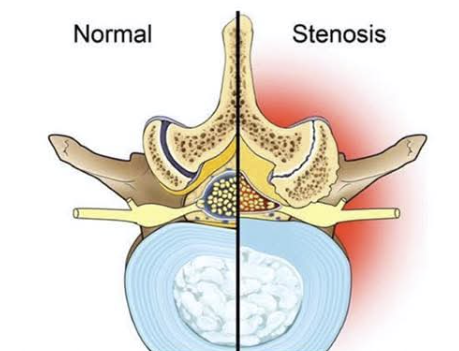
To understand why the transfacet trajectory makes sense, it helps to look at where lumbar nerve root compression actually tends to occur. As the facet joints degenerate, they don't just lose cartilage — they hypertrophy, developing osteophytes and capsular thickening as the joint tries to stabilise itself. The ligamentum flavum, which sits just anterior to the facet joint and forms part of the posterior wall of the spinal canal, responds in a similar way: with degeneration, it thickens and can buckle inward.
Together, facet joint hypertrophy and ligamentum flavum thickening are among the most common drivers of lateral recess narrowing — the corridor the traversing nerve root passes through just before it reaches the exiting foramen. The same combination often narrows the foramen itself. This is a well-recognised mechanism in the lumbar spinal stenosis literature, and it's frequently where the actual anatomical compression, and the inflammation that goes with it, is occurring — not simply somewhere further along the nerve's course.
Why the foramen is the problem
A conventional transforaminal injection places the needle tip within the neural foramen, close to the exiting nerve root, to achieve peri-radicular and epidural spread of the injectate. The foramen, however, is a tight space that also carries the radicular arteries supplying the nerve root and, at some levels, contributes to the blood supply of the spinal cord itself. Rare but serious neurological complications — including cord infarction — have been linked to inadvertent intra-arterial injection at this location, particularly with particulate steroid preparations. These events are uncommon, but they're serious enough that they've shaped how transforaminal injections are used and taught over the past two decades.
Beyond the vascular risk, the foraminal approach can simply be uncomfortable. Needle contact with, or close proximity to, the nerve root itself often reproduces the patient's radicular pain during the procedure — which is sometimes taken as a confirmatory sign of correct targeting, but is unpleasant to sit through, and can make patients tense up in a way that complicates the rest of the procedure.
What the transfacet approach changes
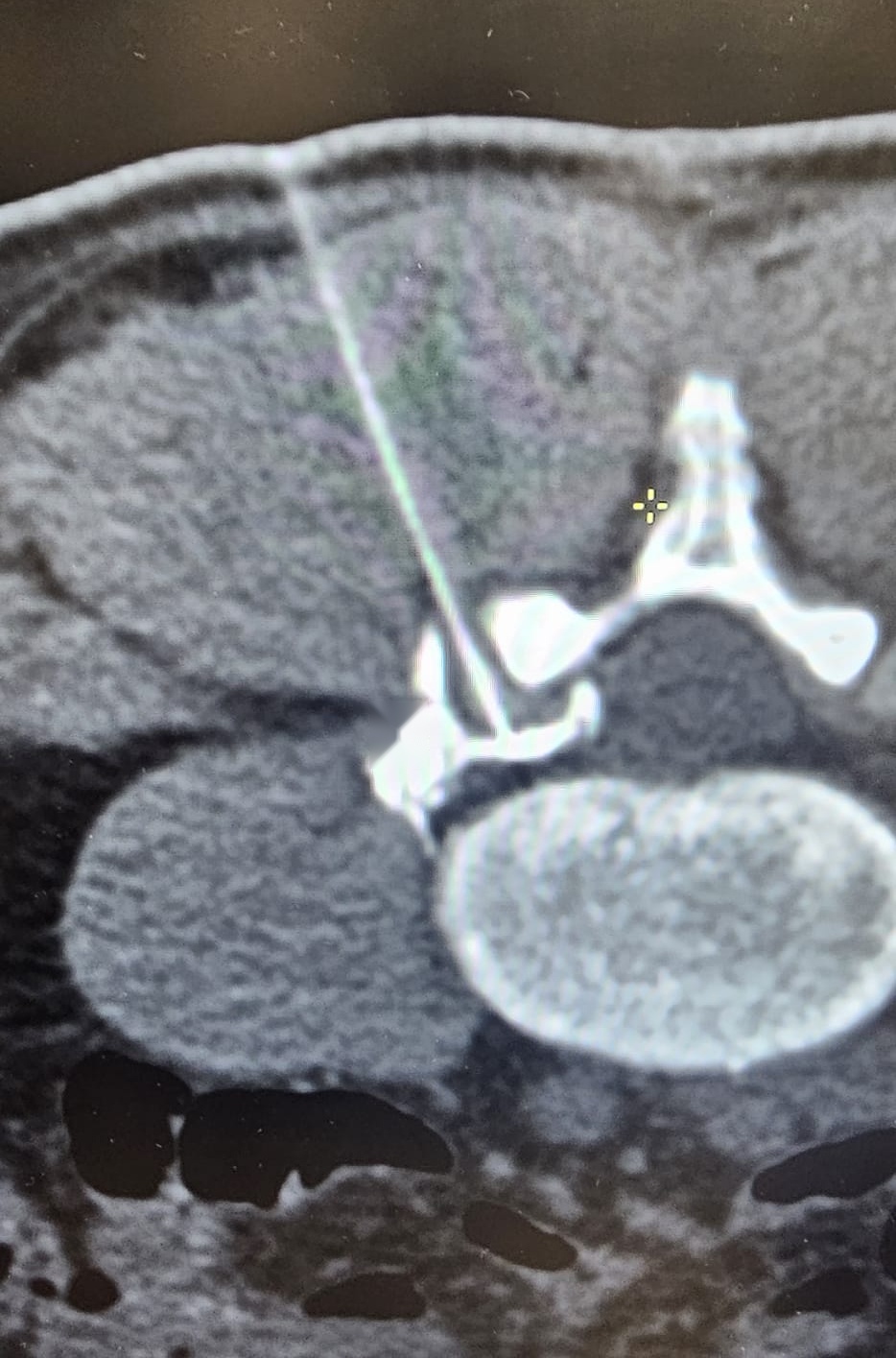
The transfacet approach reaches the perineural and epidural space by directing the needle towards the facet joint rather than into the foramen itself, using the joint as a landmark and pathway rather than the foraminal corridor. Because the needle trajectory never enters the foramen, it avoids the radicular vessels that run through it — the approach has been described in the literature as strictly avascular, which is the core safety rationale behind it.
What makes this more than just a safer detour to the same destination is that the facet joint and the adjacent, often-thickened ligamentum flavum are frequently the actual site of the pathology described above — not merely a convenient landmark on the way to somewhere else. Rather than reaching the nerve root indirectly through the foramen, the transfacet trajectory delivers the injectate directly into the region where facet overgrowth and ligamentum flavum thickening are narrowing the lateral recess and compressing the nerve in the first place.
It also tends to be better tolerated. Since the needle isn't advancing directly onto the nerve root to confirm position, patients generally don't experience the same sharp reproduction of radicular pain that's common with a transforaminal approach. A parallel line of evidence comes from endoscopic spine surgery: in endoscopic decompression performed through a transfacet corridor for severe lumbar stenosis, surgeons have reported lower rates of post-procedure dysesthesia than with a transforaminal corridor, attributed to less manipulation of the exiting and traversing nerve roots. That's a surgical decompression procedure rather than an injection, so it isn't directly comparable — but the underlying reason (less nerve root handling) is the same mechanism we'd point to for why the injection version is better tolerated too.
What's actually been published
The technique itself isn't new. A periepidural transfacet route was described over a decade ago as a way of reaching the epidural and perineural space while staying clear of the foramen, developed partly because it also suited patients on antiplatelet medication who carried a higher bleeding risk with a foraminal approach. That paper — one of the few to describe the transfacet route in real technical detail — concluded it looked like a genuinely safer alternative on anatomical grounds, precisely because it removes the needle from the vicinity of the radicular artery.
What exists: technical descriptions of the transfacet trajectory and its anatomical rationale; a CT-guided comparison of transforaminal and transfacet approaches for cervical (not lumbar) radicular pain; use of the transfacet route as a first-line option for injecting post-surgical fibrosis, where foraminal anatomy is distorted; and, in endoscopic spine surgery, a technical series describing transfacet decompression for severe lumbar stenosis, which reports good outcomes and lower dysesthesia rates than the transforaminal corridor — a surgical rather than injection technique, but supportive of the same anatomical logic.
What's thin: head-to-head efficacy data comparing transfacet with transforaminal injection specifically in the lumbar spine. Most of the comparative literature on this trajectory sits in the cervical spine, or reports technique and safety without a matched efficacy comparison.
What this practice adds: several years of lumbar transfacet perineural injections performed here, with consistently good outcomes and markedly better tolerability than the transforaminal approach — clinical experience rather than published trial data, but a track record worth noting given how little else has been formally reported for the lumbar spine.
That gap is exactly why this is worth writing about rather than something to be quiet about. A technique can have a sound anatomical rationale, a plausible safety advantage, and a favourable clinical impression, well before it has a randomised trial behind it — and the lumbar spine specifically seems to be an area where the transfacet approach hasn't yet been formally studied in comparison to the transforaminal standard. Structured case series or comparative data on the lumbar transfacet route would be a genuinely useful contribution.
Where this fits clinically
Perineural injection — targeted delivery of anti-inflammatory medication around an irritated lumbar nerve root — is generally considered for patients with radicular pain from disc herniation, foraminal stenosis or nerve root irritation, usually after simpler measures haven't settled things. Within that group, a transfacet trajectory is being used here as an alternative needle path to reach the same target, not a different treatment or a different patient selection. It's a technical refinement, assessed case by case based on individual anatomy and imaging — not a treatment that replaces clinical judgement about who should be injected in the first place.
Next step
Considering a nerve root injection?
Ask your GP about a referral, or get in touch directly to discuss suitability and technique.
Get in touch