Key facts
- What it is: genicular artery embolisation (GAE) is a day-procedure, image-guided treatment for knee osteoarthritis pain — not a joint replacement.
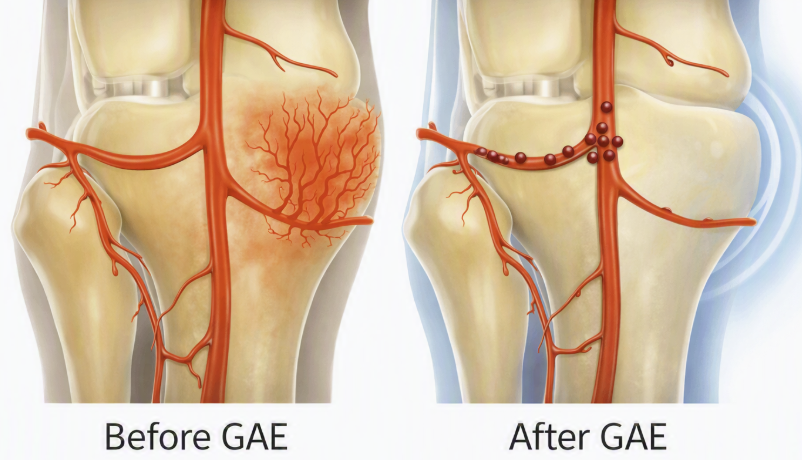
- How it works: a catheter is guided to the small arteries supplying the inflamed joint lining, and tiny particles reduce blood flow to that inflamed tissue.
- What it's for: ongoing OA knee pain despite conservative treatment, in patients not ready for — or not suitable for — joint replacement surgery.
- What to expect: local anaesthetic with light sedation, under an hour, most patients home the same day.
For most people, knee osteoarthritis follows a familiar and frustrating path: activity modification, anti-inflammatories, physiotherapy, maybe a cortisone injection — and eventually, if pain keeps progressing, a conversation about joint replacement. That path works well for many patients. But there's a real gap for people who sit in the middle: too much pain to just "manage," not quite ready for — or not suitable for — surgery.
That's where image-guided, minimally invasive options are increasingly being used as part of the conversation, alongside rather than instead of conventional care.
What's actually happening in an osteoarthritic joint
Osteoarthritis involves the gradual breakdown of cartilage that cushions the joint, along with changes to the underlying bone and surrounding soft tissue. As the joint lining becomes irritated, it can develop increased blood flow — new, small blood vessels form in the joint lining, particularly in areas that are inflamed. It's this abnormal blood supply that some newer treatments are designed to target directly.
What is genicular artery embolisation?
Genicular artery embolisation (GAE) is a day-procedure, image-guided treatment for knee osteoarthritis pain that reduces blood flow to the inflamed lining of the joint, without replacing the joint itself. Using x-ray guidance, a thin catheter is guided through the blood vessels — usually from a small access point at the wrist or groin — to the small arteries that supply the lining of the knee joint. Tiny particles are then released to reduce blood flow to the inflamed areas contributing to pain.
It's performed under local anaesthetic with light sedation, typically takes under an hour, and most patients go home the same day. It doesn't replace the joint or remove any bone — it targets one of the drivers of pain rather than the structural wear itself.
Who tends to consider it
GAE and similar image-guided options are generally discussed with patients who:
- Have ongoing knee pain from osteoarthritis despite conservative treatment (physiotherapy, weight management, anti-inflammatories, injections)
- Aren't ready for, or aren't suitable candidates for, joint replacement surgery
- Want to understand the full range of options before committing to a surgical pathway
It isn't the right fit for everyone — suitability depends on imaging findings, the pattern and severity of arthritis, and overall health. That's assessed properly in consultation, not from a description online.
How it sits alongside other MSK options
GAE is one part of a broader toolkit that also includes image-guided joint injections, PRP (platelet-rich plasma) therapy, hyaluronic acid injections, and spinal or peripheral nerve injections for related pain. Which option — if any — makes sense depends on where the pain is coming from, how far the joint changes have progressed, and what a patient has already tried.
Next step
Wondering if this applies to you?
Ask your GP about a referral, or get in touch directly to discuss suitability.
Get in touch