Key facts
- What it is: a day-procedure, image-guided treatment for knee osteoarthritis pain — an alternative to ongoing pain management, not a joint replacement.
- How it works: a catheter is guided to the genicular arteries supplying the inflamed knee lining, and tiny particles reduce blood flow to that inflamed tissue.
- Who it suits: patients with ongoing knee OA pain despite conservative treatment, who are not ready for — or not suitable for — knee replacement.
- What to expect: local anaesthetic with light sedation, under an hour, most patients home the same day.
Genicular artery embolisation (GAE) is a minimally invasive, image-guided procedure for chronic knee pain caused by osteoarthritis. Performed by an interventional radiologist under X-ray guidance, it targets one of the drivers of joint pain — abnormal blood flow to the inflamed joint lining — without removing or replacing any part of the knee.
How GAE works
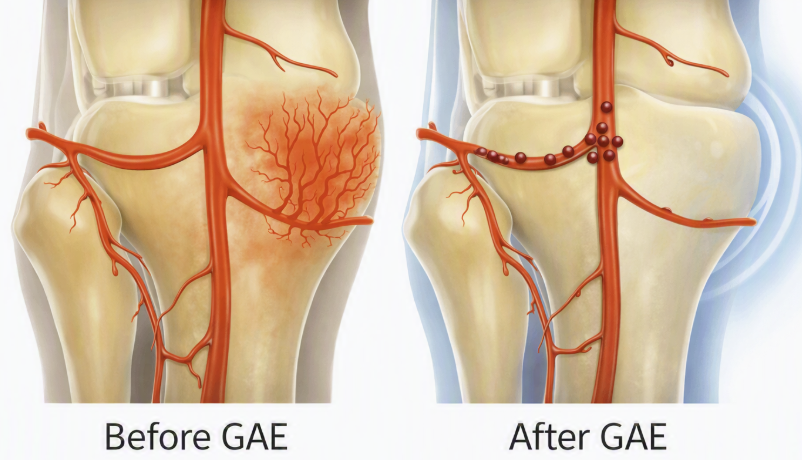
As a knee joint becomes osteoarthritic, the lining of the joint (the synovium) often develops increased, abnormal blood flow as part of the inflammatory process. GAE targets this directly: a thin catheter is guided — usually from a small access point in the wrist or groin — into the small genicular arteries that supply the inflamed synovium. Tiny embolic particles are then released to reduce blood flow to those specific areas, calming the inflammation that's contributing to pain.
It's performed under local anaesthetic with light sedation, typically takes under an hour, and is done as a day case. It doesn't involve removing cartilage, bone, or any part of the joint — it targets the inflammatory driver of pain rather than the structural wear itself.
Who is a candidate for GAE
GAE is generally considered for patients who:
- Have ongoing knee pain from osteoarthritis despite conservative treatment — physiotherapy, weight management, anti-inflammatories, or joint injections
- Have mild-to-moderate radiographic osteoarthritis (broadly Kellgren-Lawrence grade 2–4)
- Aren't ready for, or aren't suitable candidates for, knee replacement surgery
- Want to understand the full range of options before committing to a surgical pathway
Suitability depends on imaging findings, the pattern and severity of arthritis, and overall health — assessed properly in consultation rather than from a description online.
What the evidence shows
GAE was first used to manage bleeding into the joint (hemarthrosis) after knee replacement surgery, and its use for osteoarthritis pain specifically was first reported by Okuno and colleagues in 2015. Since then, a growing body of clinical evidence — including multiple meta-analyses — has supported its safety and efficacy for patients with mild-to-moderate osteoarthritis who haven't responded adequately to conservative treatment, particularly those who are not good candidates for surgery due to other health factors or personal preference.
What's established: GAE reduces pain and improves function in appropriately selected patients with mild-to-moderate knee OA, with a good safety profile — reported risks are generally mild and include bruising at the access site and a temporary flare of knee discomfort.
What's still developing: as a newer technique relative to joint replacement, longer-term outcome data and refinement of patient selection criteria continue to accumulate. It's discussed as a complement to, not a wholesale replacement for, the existing OA treatment pathway.
Read our fuller explainer on osteoarthritis and where GAE fits in the broader treatment picture for more detail on the joint changes GAE is designed to address.
Common questions
What is GAE used for?
GAE is used to treat chronic knee pain from osteoarthritis in patients who have ongoing pain despite conservative treatment and are not yet ready for, or not suitable for, knee replacement surgery.
Is GAE the same as a knee replacement?
No. GAE does not replace or remove any part of the joint. It reduces blood flow to the inflamed joint lining to relieve pain, while the underlying joint structure remains unchanged.
How long does GAE take and what is recovery like?
The procedure typically takes under an hour and is performed as a day case — most patients go home the same day. Mild bruising or a short-term flare of knee discomfort at the injection site is common and usually settles within days.
Do I need a referral for GAE?
Yes, a referral from your GP or specialist is generally required, along with relevant knee imaging, so suitability can be properly assessed.
Next step
Wondering if GAE applies to you?
Ask your GP about a referral, or get in touch directly to discuss suitability.
Get in touch